
The Boeing B-29 Superfortress arrived in Marietta as blueprints, federal money, trainloads of steel, and an industrial assignment bordering on the absurd. Build one of the most advanced airplanes on Earth in a Georgia town with little experience in aircraft manufacturing.
Marietta accepted the job.
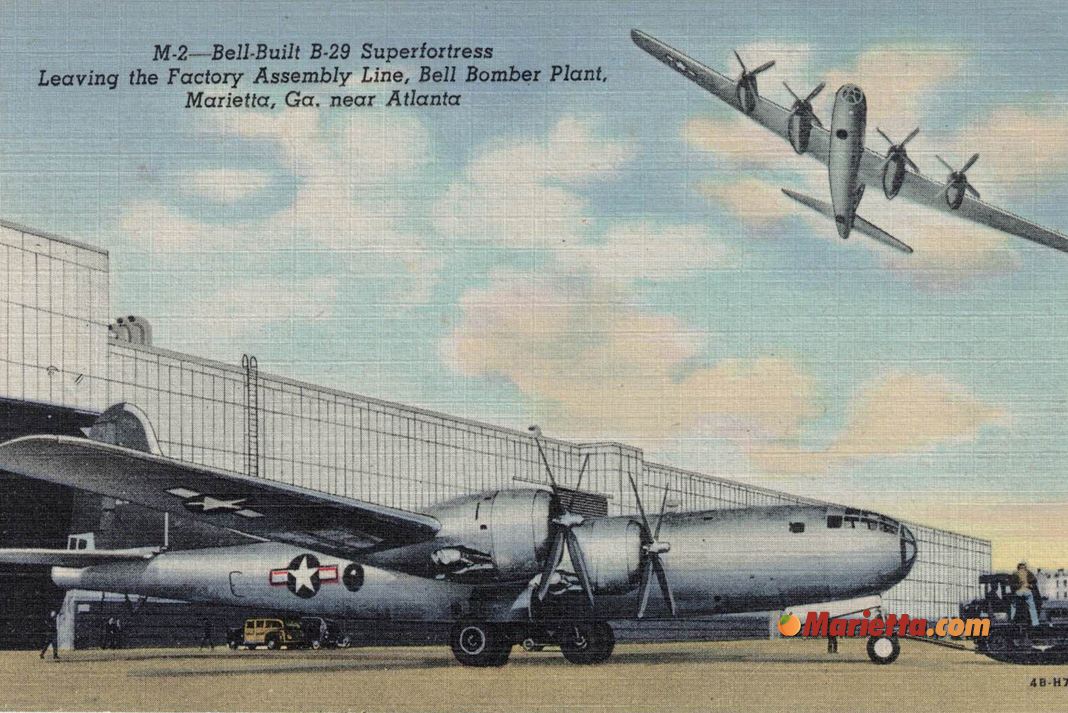
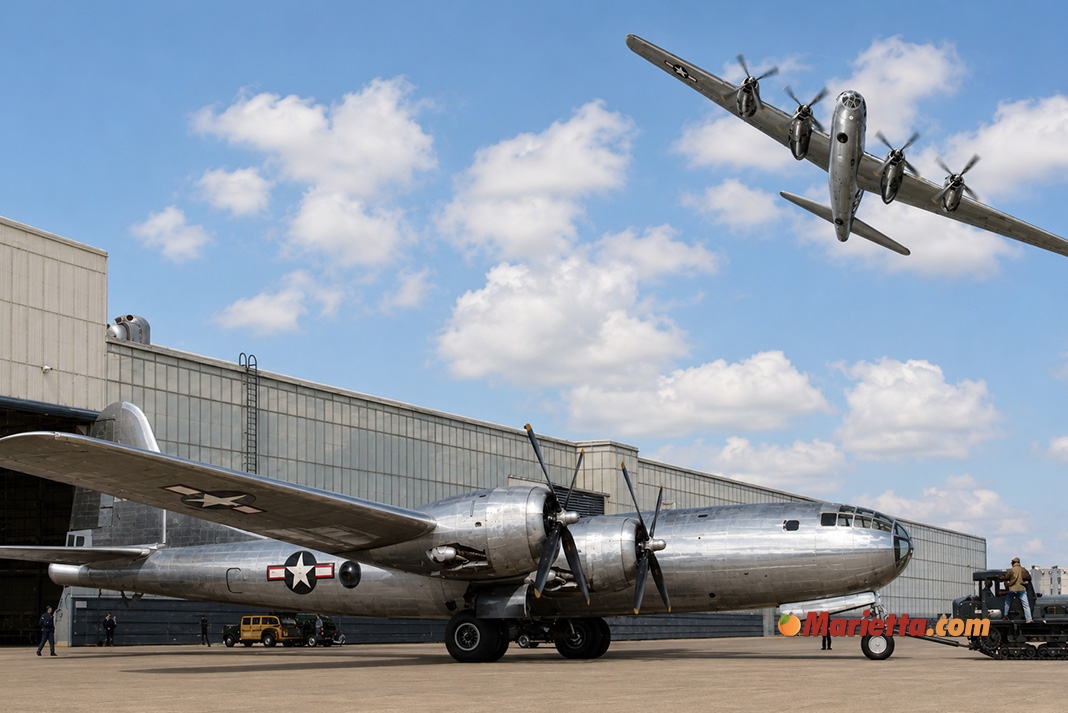
Between 1943 and 1945, thousands of employees at the Bell Aircraft plant assembled B-29 bombers for the U.S. Army Air Forces. The enormous factory beside the airfield altered Marietta’s economy, population, and future. The site later became Air Force Plant 6, home of Lockheed Georgia and present day Lockheed Martin operations. Nearly every major chapter in Marietta’s aviation history begins with the same polished aluminum giant.
What Was the B-29 Superfortress?
Boeing designed the B-29 as a replacement for the B-17 Flying Fortress and B-24 Liberator. Its first flight took place on September 21, 1942, while the United States was rapidly expanding its ability to strike targets across the vast distances of the Pacific.
The aircraft was immense. It measured 99 feet long, had a wingspan of more than 141 feet and reached nearly 28 feet in height. Four Wright R-3350 engines, each producing about 2,200 horsepower, pushed it to a maximum speed of roughly 357 mph. Its range reached approximately 3,700 miles, and it could fly above 33,000 feet. A standard B-29 could haul up to 20,000 pounds of bombs.
Those figures were impressive, but the technology inside the fuselage made the airplane extraordinary. The B-29 was the first bomber with pressurized crew compartments, allowing personnel to operate at high altitude without spending an entire mission dressed like mountaineers trapped inside a metal freezer. It also featured remotely controlled gun turrets connected to an advanced central fire control system. Analog computers helped gunners account for speed, range, altitude and other variables.
It was an airplane, a pressure vessel, a gun platform, and an electrical engineering problem with wings. Keeping four temperamental engines operating added another layer of suspense.
Why Boeing Bombers Were Built by Bell
Despite the Boeing name, Boeing did not manufacture every B-29. The wartime program was too large and urgent for one company or factory. Boeing operated production plants in Wichita, Kansas, and Renton, Washington. The Glenn L. Martin Company built B-29s near Omaha, Nebraska. Bell Aircraft received responsibility for another government financed plant in Marietta.
Bell had been founded in Buffalo, New York, in 1935 and was producing the P-39 Airacobra when the United States entered World War II. About two weeks after the attack on Pearl Harbor, the federal government selected Bell to manufacture the new Boeing bomber in the Atlanta area.
The next question was where to put the factory.
How Marietta Won the Plant
Marietta entered the competition with several advantages. It was fewer than 20 miles from Atlanta, near major rail connections, U.S. 41 and a new airfield known as Rickenbacker Field. Local leaders had pushed for the airfield before the United States entered the war, originally viewing it as a commercial aviation project. Its military value soon became obvious.
General Lucius D. Clay also played an important role. Clay was a Marietta native and the son of former 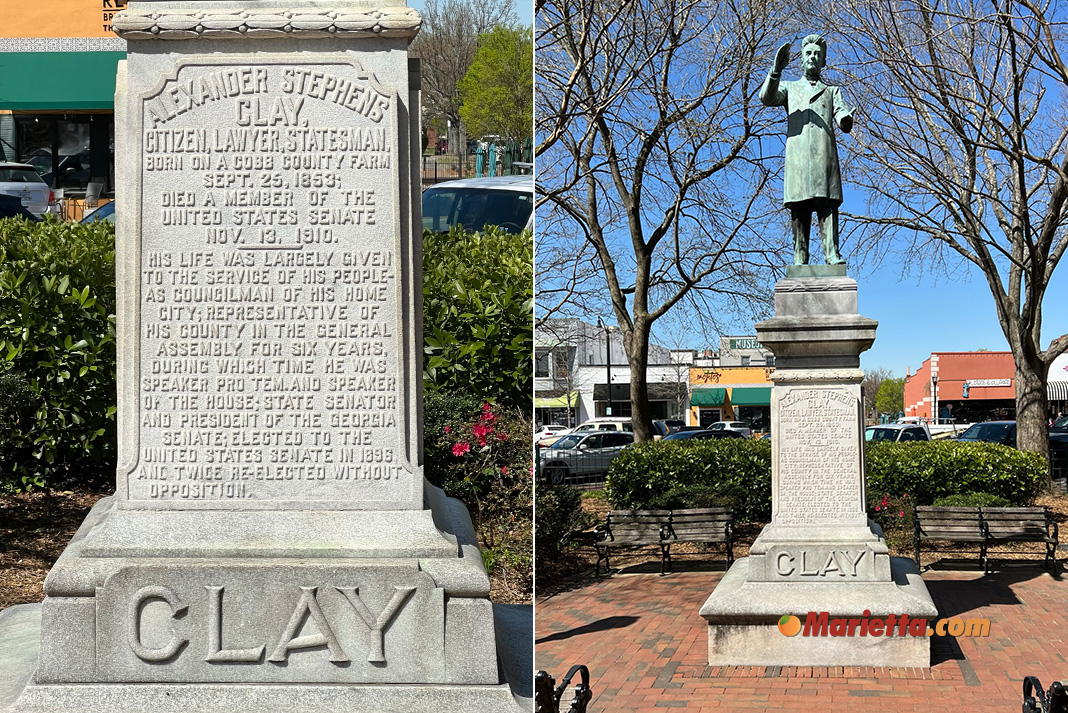 U.S. Senator Alexander Stephens Clay. By 1942, he held considerable influence over military construction and procurement. His support helped persuade the War Department to select Marietta over other sites around Atlanta. The decision was announced on February 19, 1942.
Construction began at a wartime pace. Atlanta based Robert and Company designed and managed the project. The main assembly building covered more than 3.2 million square feet. With administration buildings and other facilities included, the complex approached 4.2 million square feet. The main building took about 13 months to complete.
The original estimate placed the project at $15 million. By the end of the war, federal investment had reached approximately $73 million. Apparently, even in 1943, a major construction project could discover a few expenses along the way.
The Bell Bomber Plant Goes Into Production
The plant began operating in the spring of 1943. The first B-29 assembled entirely in Marietta emerged from the factory that November, and Bell began delivering aircraft before the end of the year. The Bell operation in Marietta is credited with supplying 663 B-29s to the Army Air Forces during the war.
Production required a workforce far beyond the pool of experienced aircraft employees available in north Georgia. Bell brought experienced personnel from Buffalo, then hired and trained people from across Georgia and the South.
Employment peaked at 28,158 in February 1945. About 90 percent of the employees were southerners, and many came from towns across north Georgia. Women represented approximately 37 percent of the payroll. Black employees accounted for about 8 percent, while employees with physical disabilities represented roughly 6 percent.
The factory offered better wages and technical training than many other employers in the region, but it did not suspend Jim Crow. Job areas remained segregated, and advancement opportunities for women and Black employees were limited. The bomber may have represented the future of aviation, but parts of the factory remained firmly parked in the past.
James V. Carmichael, a Marietta attorney and political figure, became general manager in late 1944. Under his management, Bell continued meeting production requirements. During production, the plant tested and delivered its bombers without a fatal delivery or test flight crash, a significant record for an airplane known for difficult engines and early development problems.
From Marietta to the Pacific
The B-29 was designed with Europe in mind, but its range made it especially valuable against Japan. The Army Air Forces first deployed the bomber to Asia, launching missions from bases in China. Later operations from Saipan, Guam, and Tinian placed Japanese industrial centers within easier reach.
B-29 crews dropped conventional explosives, incendiary bombs, and naval mines. The bombing campaign destroyed factories, transportation networks, and large sections of Japanese cities. It also killed vast numbers of civilians, a human cost inseparable from the aircraft’s history.
The B-29 is most widely associated with the atomic bombings of Hiroshima and Nagasaki in August 1945. Neither Enola Gay nor Bockscar came from the Marietta assembly line. Both were built by the Glenn L. Martin Company near Omaha as part of the specially modified Silverplate program. Enola Gay dropped the first atomic weapon used in combat on Hiroshima on August 6. Bockscar dropped a second weapon on Nagasaki three days later.
Marietta employees did, however, manufacture hundreds of aircraft used in the wider B-29 campaign. Their work placed north Georgia inside one of the largest industrial and military programs of World War II.
The Factory Changes Marietta
Before Bell, Marietta was the government and commercial center of a largely rural county. The plant introduced industrial payrolls, technical trades, and a huge influx of residents.
Marietta’s population grew from 8,667 in 1940 to 20,687 by the end of the decade. Cobb County reached about 62,000 residents by 1950, an increase of more than 60 percent in ten years. Housing, roads, schools and businesses expanded around the new employment base.
The transformation reached far beyond wartime aircraft production. Thousands of local employees had learned manufacturing, engineering, inspection, and management skills. Marietta had proven that a huge aerospace operation could recruit, train, and retain a southern workforce.
The courthouse town had acquired a factory floor measured in acres. There was no realistic way to put that genie back in the bottle, especially since the genie now knew how to operate a rivet gun.
Bell Leaves and Lockheed Arrives
After Japan surrendered, the government canceled the B-29 contract. Bell reduced employment rapidly, and the plant closed. The main assembly building became storage space for machine tools, while government agencies occupied portions of the administration complex.
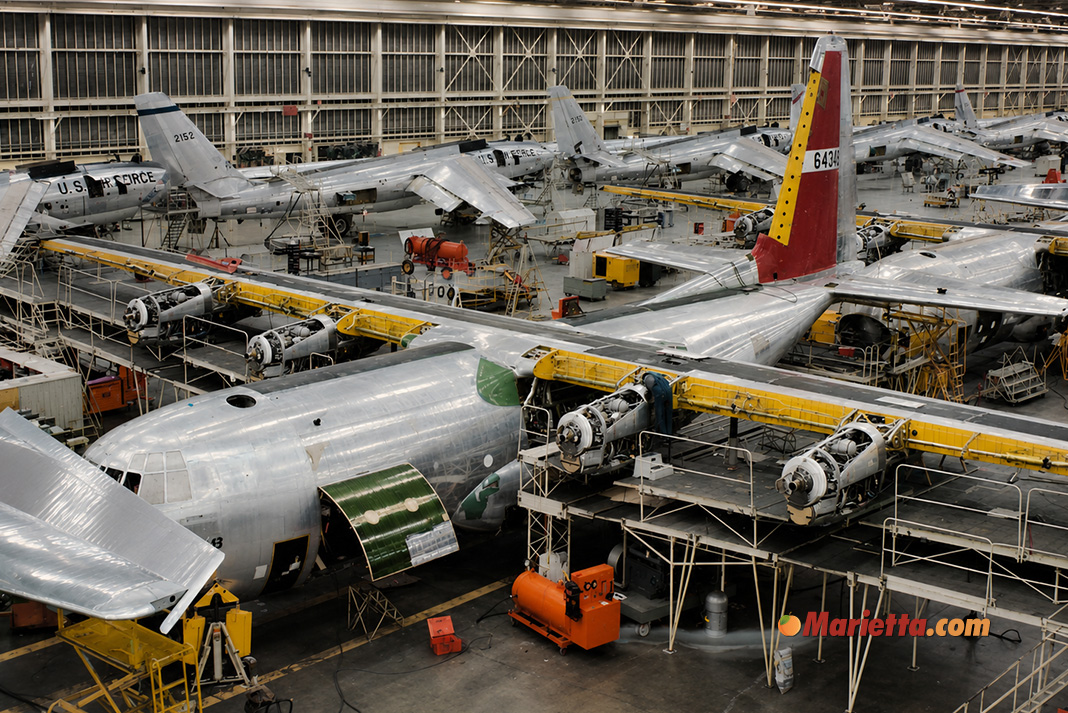
The closure lasted until the Korean War created another need for military aircraft. In January 1951, the Air Force invited Lockheed to reopen the factory. Its first assignment was refurbishing B-29s for combat service in Korea. James V. Carmichael returned as the first general manager of Lockheed’s Georgia division and supervised the refurbishment of 120 bombers.
Lockheed later produced or modified aircraft including the B-47 Stratojet, C-130 Hercules, C-141 Starlifter, C-5 Galaxy, P-3 Orion and F-22 Raptor at the Marietta site. The facility is officially known as Air Force Plant 6 and remains operated by Lockheed Martin.
The corporate name changed. The aircraft changed. The industrial foundation created for the B-29 remained.
Sweet Eloise at Dobbins
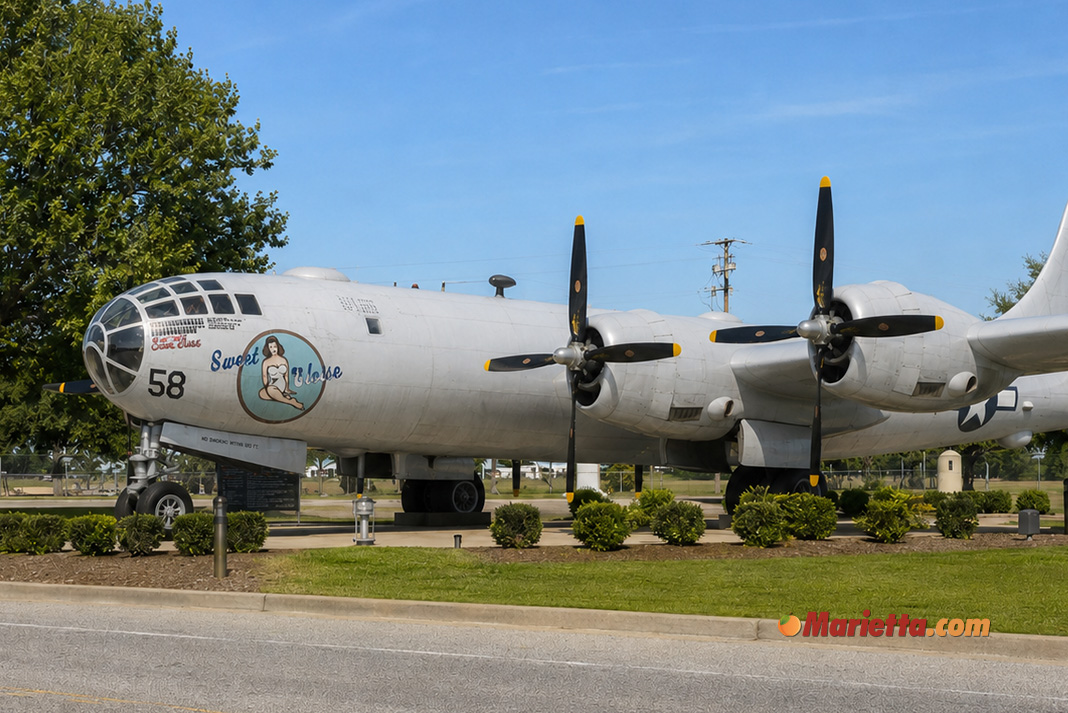
A surviving B-29 named Sweet Eloise is displayed near the entrance to Dobbins Air Reserve Base. It was unveiled there on May 6, 1997, during a ceremony attended by several hundred people and Georgia Governor Zell Miller. The aircraft’s first pilot, Lt. Col. Ray Clinkscales, attended with Eloise Strom, its namesake.
Sweet Eloise was built in Wichita rather than Marietta, but its placement recognizes the bombers and employees associated with the Bell plant. The aircraft provides a physical reminder of the scale involved. A B-29 in a photograph looks graceful. A B-29 viewed from the ground looks like somebody misplaced a four engine office building.
The B-29’s Place in Marietta History
The B-29 never became a permanent product of Marietta. Production lasted only a few years, and Bell departed after the war. Yet the bomber established the aerospace economy that followed.
The plant brought federal investment, skilled industrial employment, and tens of thousands of new residents. It helped shape Dobbins Air Reserve Base, provided the factory later occupied by Lockheed, and placed Cobb County inside the American aerospace industry.
Every C-130 or C-5 associated with the Marietta plant belongs to a history that began when Bell employees learned to assemble Boeing’s complicated new bomber under wartime pressure. The B-29’s combat record remains difficult, powerful, and often grim. Its local legacy is easier to see. Modern Marietta was built partly with aluminum, rivets, and four enormous Wright engines.