









Introducing Arts Into the STEM Curriculum
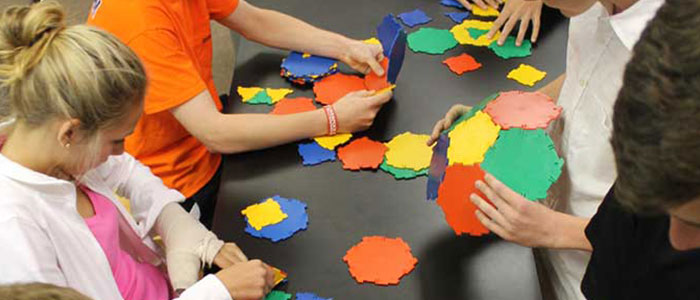

STEM, referring to careers in science, technology, engineering and mathematics, is typically used to improve competitiveness in technology development in schools serving kindergarten through college-aged students. In 2006, after the United States National Academies expressed concern over the decline in STEM education, there was a push to advance it and eventually schools at the national and state levels were able to earn STEM certifications. This means that schools offer an integrated curriculum where science, technology, engineering and math are taught together to drive problem solving, discovery and student-centered development of ideas.
 In time, there’s been a push to add arts, or an “A,” to the curriculum, transitioning it into “STEAM.” Marietta Center for Advanced Academics (MCAA) Principal Jennifer Hernandez, whose school is Georgia’s first STEM certified school, says Virginia educator and developer of the International STEAM Framework, Georgette Yakman, first coined the term. “Science and technology are understood as the basis of what the world has to go forward with, to be analyzed and developed through engineering and the arts, with the knowledge that everything is based in elements of mathematics,” Hernandez says. “It is a contextual curriculum where the subjects are coordinated to co-support each other under a formal educational structure of how science, technology, engineering, mathematics and the broad spectrum of the arts all relate to one another in reality. This framework not only includes the art of aesthetics and design, but also the art divisions of the liberal, language, musical, physical and manual.”
Hernandez also says that the STEAM structure explains how all divisions of education and life work together, therefore offering a formal place in the STEM structure for language arts, social students and the purposeful integration of the exploratory subjects including; the arts, music and physical education. “Shifting to a STEAM perspective means understanding learning contextually; not only in terms of having a framework that illustrates where the subjects overlap, but also in providing a living and adaptable learning structure for ever-changing personal and unpredictable global development.”
The conversation about integrating arts into MCAA’s STEM curriculum began in 2012, says Hernandez. “We wanted to make sure we were successful with arts integration, so we started by infusing engineering in our arts classes.” For the 2013 – 2014 school year, she hired a part-time arts teacher with the help of a charter school grant through her district, Marietta City Schools, and a second full-time arts teacher, who was previously a graphic artist that earned her masters in art education from Cobb’s very own Kennesaw State University. “The arts will be used as a vehicle to infuse the 21st century skills of collaboration, communication, critical and creative thinking into engineering design,” Hernandez says. An example of how students are already practicing this is in projects like the Build Your Own Instrument Challenge, The House That Rhythm Built and What Does Weather Look Like? The school has also invested in a 3D printer to implement real-world engineering designs and the development of student-driven products. “Research shows that representing concepts in tangible form greatly increases understanding of that concept,” Hernandez says.

The Walker School, a Marietta private school that has emphasized the importance of arts in the curriculum, especially in the last 10 years, very deliberately doesn’t allow students to focus on just one subject area, and in all grades. “Many of our students who take advanced sciences courses are also acting in the musical, playing in our concert band or showcasing their artwork in our galleries on campus,” says Katie Arjona, chair of Walker’s Fine Arts Department. Like Hernandez, Arjona says the drive behind including arts in the curriculum is to keep a student’s learning balanced. “They are better prepared for future careers when they have a diverse skill set,” she says. “We have alumni who say that to us all the time. Students need the arts to help them be better communicators, increase their confidence, understand and learn to cope with rejection and failure, learn to work in groups, see beyond what is right in front of them and approach projects or problems with a keen and creative eye.”
 A local corporation, Lockheed Martin Aeronautics, prides itself on working closely with educators, policy makers and families to develop programs that educate and inspire tomorrow’s scientists, engineers and mathematicians. The company employs 60,000 engineers, scientists and IT professionals nationally, and approximately 50 percent of Lockheed’s philanthropy is focused on STEM. In Cobb County alone, nearly 375 volunteers have worked with more than 20,000 students on activities including the Atlanta Science Festival, robotics team support, corporate site tours, Society of Women Engineers and the Explore program, just to name a few. “America is facing a shortage of engineers today and our education system is not turning out nearly the numbers of engineers companies like mine will need to hire for years to come,” says Shan Cooper, Lockheed Martin vice president and general manager, Marietta operations. “While our industry is focused on technology and innovation that largely come from the STEM side, we fully understand that a well-rounded education also includes an arts component. We just need to ensure the system provides the right mix of all disciplines to secure our students’ and our country’s futures.”
Chattahoochee Technical College, also located in Marietta, is a higher ed partner that has been very proactive in integrating arts into the STEM curriculum. “Students in STEM fields will be pushed academically, and they will engage in hands-on learning, critical thinking and other important skills,” says Dr. Jason Tanner, dean for Arts and Sciences at Chattahoochee Tech. “I think courses in art and design areas allow students to see application of those STEM fields. I also believe that classes in art and design areas will demand that students be creative and use that creativity and imagination in practical settings.” Tanner says that like most accredited colleges, his school requires students to take courses in Humanities areas where arts-centered classes are offered. “By requiring a course in this area, just as we require a college-level math course, [Chattahoochee Tech] is demonstrating the importance of a student’s well-rounded education, but the college is also demonstrating how these must work in tandem.” Other area state colleges and universities partnering with schools and organizations that promote STEM and STEAM include Southern Polytechnic State University, Kennesaw State and Georgia Tech.



 There are ways to deter these pests from invading your home or business, both inside and out. Tiffani Jenkins, who owns and operates ABC Home & Commercial Services in Marietta with her husband Benjamin, says most insects need food and moisture to survive, so by eliminating or reducing these elements, infestations can be prevented. “Gutters should be free of debris. Trees and shrubs should be trimmed and kept from touching the dwelling as this is another way insects are invited inside,” she says. “For termite prevention, it is recommended to choose pine straw as opposed to wood mulch that might invite termites to inhabit areas around the foundation of your home.” The Jenkins opened their Church Street location in 2012.
 And if or when pests do become a nuisance around your home or business, there are ways to exterminate the problems. Adam Vannest, director of Training and Technical Services with Northwest Exterminating, recommends calling in a professional to help. “Proper identification of an infestation is essential to your treatment plan and can prevent overspending and mistreatment of an area,” he says. “After your home or business has been treated, it is important to maintain a regularly scheduled, year-round pest control service. Following your customized treatment plan and recommendations will help aid in keeping a pest-free home or business.” Northwest, which has been in business for 63 years, has four Cobb locations.

 High productivity, a direct result of higher morale, is a competitive advantage, one that companies should strive not only to maintain but increase. One of the oldest and largest background check companies in the country, InfoMart, employs 100 people and 120 in its peak seasons. Founder Tammy Cohen recalls working for employers that didn’t recognize or support their workforce emotionally. “People spend a good portion of their life at work; it is important that people are happy where they work, and that they go home happy to their families,” she says. “From the first employee, InfoMart has always placed just as much emphasis on morale as we have on profit.” Cohen says that investing in morale has a high return on investment.